
Momentum is a Battery, Not a Motor
Why treating momentum as a battery is key for me as a solo builder.

In my last post, I talked about how I incorporate external “circuit breakers.” I mentioned things like my cat meowing at 11 am or my hobbies to prevent me from just working all day without stopping. Today I’m taking this a step further by tackling the intersection of momentum and sustainability.
In the tech world, we are often conditioned to think of momentum as a motor. We are encouraged to grind and keep pushing until we hit an exit. As someone building solo, this feels dangerous for me given my prior post.
Motors require a constant, external stream of fuel. When the fuel, whether it is dopamine, novelty, or caffeine, runs out, the motor stalls. Getting a cold engine to turn over again can be harder than if you had just taken a more measured approach from the start.
The Battery Philosophy
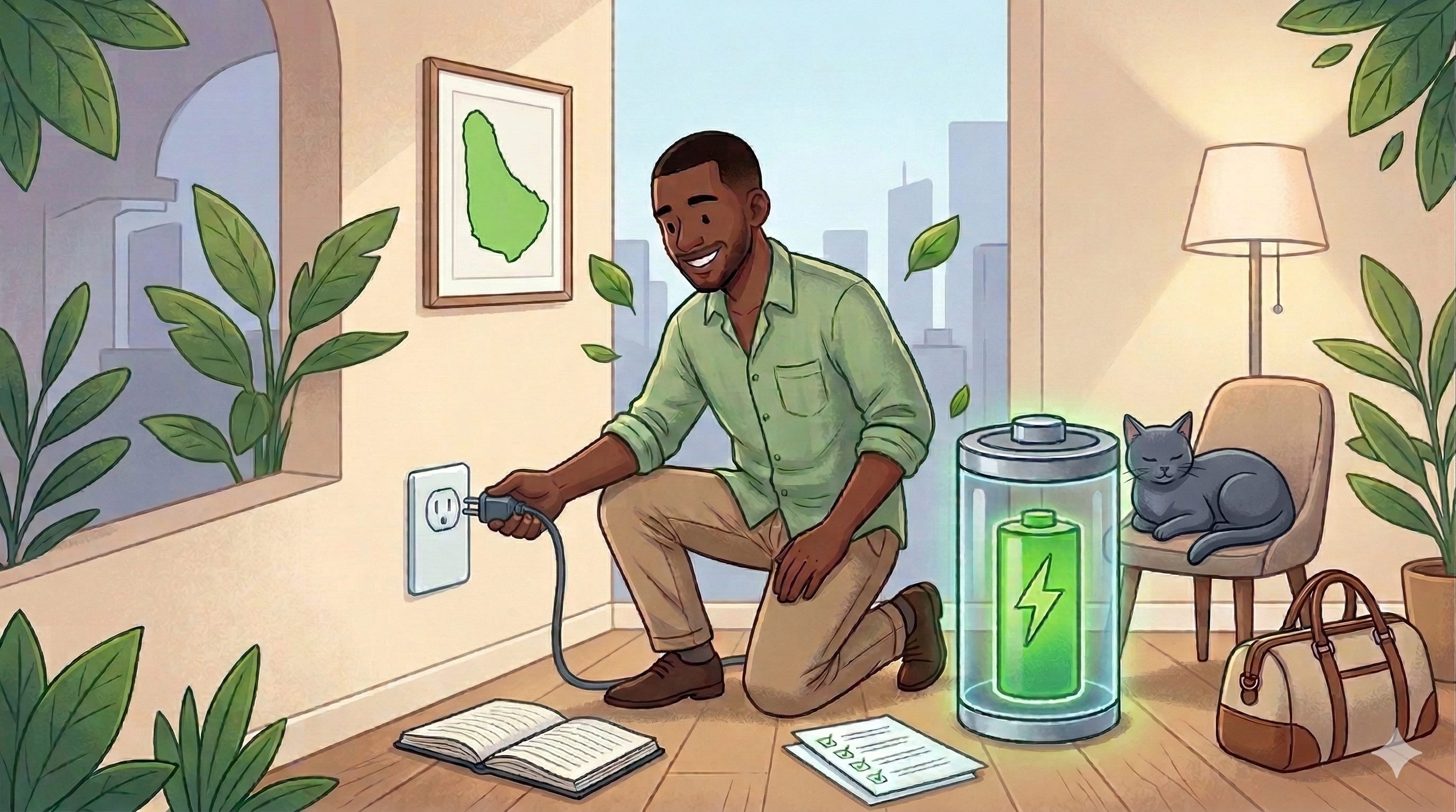
Nowadays, I try to approach my work as if momentum is a battery. It has a specific set of characteristics that reflect the reality of solo building:
Finite Capacity: You only have so much “high-voltage” focus in a day.
Natural Decay: Energy leaks if it is not used intentionally.
Cycle Life: Most importantly, a battery has a limit on how many times it can be recharged before it starts to fail.
If you “deep discharge” your battery to 0% every day, you are not being productive. You are permanently damaging the cells. This is what burnout looks like.
Avoiding the “Giant” Drain
Certain things act as a parasitic drain on your battery. One of the biggest is Comparisonitis, or in other words, looking at what established giants in your space are doing.
It is vital to remember who you are building for, not who you are competing against. Often, focusing on the user leads to a realization that there are many problems giants are now too big to solve. These gaps might not move the needle for a 500-person company, but they can still have big impacts for you and your customers. This is where I plan to spend my time with Area 246 and projects like Cari and Bajan Buddy.
Matching Task to Voltage
I also constantly remind myself that small progress is still progress. I try to match my task to the energy level I have rather than trying to “fake it until I make it.”
On High-Voltage Days: I tackle the big features and complex architecture.
On Low-Voltage Days: I do the small tasks like documentation, UI tweaks, or backlog grooming.
That is okay. It is similar to gym days where even showing up feels like a win. Small tasks also sometimes get me warmed up in a way that a large, looming task might not. It helps me avoid the friction of a “cold start.”
Be Back Next Month!
I am about to go on vacation for 3 weeks and I am explicitly not taking my computer. Why? Because there has probably not been a day this year that I have not been on it in some form. Time for a bit of an extended recharge!